 |
|
 |
|
       |
REVIEWS Symmetrical Warm-Ups: Short Daily Exercises to Build Flexibility and Strength
Throughout the book, Tsitsaros takes a scholarly approach to his subject, emphasizing the importance of coordinated hand and arm motions and connected full-body motion. An interesting discussion of Chopin’s unfinished Sketch for a Method points out the common overemphasis of the thumb, which should serve only as an auxiliary to the other four fingers of the hand; therefore, it is best placed on the very edge of the white keys. Tsitsaros also cites Heinrich Neuhaus’s The Art of Piano Playing as a guide to graceful, coordinated playing, and Carl Philipp Emanuel Bach’s Essay on the True Art of Playing Keyboard Instruments as a guide to fingering. The author suggests ways in which to use these warm-ups that can be combined within a practice session, as well as ways in which to practice them. He directs the pianist to play “in a mildly slow tempol piano to mezzo forte, with clear and slightly exaggerated hand motion,” or “Mezzo-fort, legato, at moderate tempo, somewhat reducing the hand travel.” Within the book’s sixty-nine pages, there is a wide choice of patterns, some of which-even the short ones-take some thought to comprehend or transpose. But the sounds prove interesting, and the patterns are comfortable. Once familiar with content and format, one can use the book in a flexible manner, taking advantage of the varying lengths and levels of these exercises. Susan Osborn, Keyboard Companion, March/April 2012.
Review of TSITSAROS Recuerdos de Taos. 2 Night Pieces. Dramatic Variations after a Reading of Primo Levi’s “Survival in Auschwitz” • Christos Tsitsaros (pn) • CENTAUR 2856 (72:55) from Fanfare May/June 2008 The music of Tsitsaros reflects not only his keen sense for what the instrument can do, but also a sensitive and emotionally subtle handling of potentially mawkish subject matter. Recuerdos de Taos is a set of 12 brief reflections on the natural beauty of Taos and the surrounding landscapes. Although his notes, as well as the individual titles, refer to the Indian and Spanish influences that infuse the American Southwest, the music seems more influenced by nature, as reflected in a gentle, impressionistic palette. The Night Pieces are in the spirit of the great nocturnes of the repertoire. Dramatic Variations after a Reading of Primo Levi’s "Survival in Auschwitz” is exactly what it says, in 16 variations on an original theme. This is a work of subtle power, encountering such observations of Levi as silent sobs over a stolen slice of bread, cries in snow and ash, and ending with music box memories “lost in the wind.” Even in the variation entitled “Toward the chamber,” Tsitsaros skirts the risk of bathos. His musical reflections on this unbearable subject are individualistic, an emotional trajectory devoid of histrionics. This is a strong and eloquent voice in the contemporary world of piano music. I look forward to futures encounters. FANFARE: Peter Burwasser
Reviews of CD release Piano Works by Christos Tsitsaros Centaur Records CRC2382
(Records International Catalogue, September 1998, p.19.) Pianist-composer Christos Tsitsaros was born
in Cyprus in 1961, and received his formative education in
the United States. He states in his program notes that
he began improvising as soon as he started playing, at the
age of seven. That extemporaneous quality of music making
has continued to inform his mature work. His 1993 None Tales
is a good example. The work is a suite of brief impressions,
between one and three minutes in duration, ranging from syncopated
dances and jazzy melodies pinned down with driving bass lines,
to concise contrapuntal exercises. One can imagine the
pianist happily working out the tuneful snippets at the instrument. The
music is simple, fresh, and enjoyable, like a good peasant
meal. Christos Tsitsaros plays his own music with vigor and precision. This is a fine album of uncomplicated, accessible new piano music. (Fanfare, November/December 1998, pp. 349-350.)
Review of Songs Without Words American
Music Teacher, Feb-March,
2005 by Virginia
Houser This imaginative
collection is a fresh addition to the late-intermediate piano
repertoire that will motivate students with its beautiful sounds
and emotional appeal. The opening piece, "A Winter Fable," is immediately appealing with its spacious open writing, giving ample opportunity for balanced phrasing and dynamic shading between the sequenced patterns. "Scherzo" requires lightness in fingerwork and pedaling. The wide dynamic range with sudden changes, detailed pedal indications and passages of finger legato make "Searching" one of the more challenging pieces in the collection. "Mirage" effectively incorporates a continuous bass rhythmic ostinato. "On the Wings of a Song" is a small toccato with alberti-like accompaniment figuration that must be balanced against the melody. The delightful "Milonga De Los Ninos" contains a repetitive Latin style dance rhythm. The toccato-like B section of "Sounds of the Rain" is framed by contrasting A sections of gentle patterns with an Asian flavor. From pre-college students to adult players, fro private or recital settings, this poetic music will entertain and satisfy. Reviewed by Virginia Houser, NCTM, Manhattan, Kansas.
biography | audio clips | publications | recordings | upcoming events | reviews | contact |
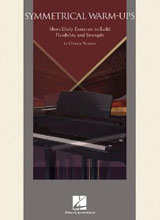 This is an interesting collection of well-thought-out warm-up exercises for the serious pianist. In a highly intelligent preface, Tsitsaros emphasizes the importance of soundly warming up. Citing an article by Christine Zaza, he builds an argument for warming up at the piano versus performing stretches that, done incorrectly, can actually cause harm. With this collection of short, progressively more difficult exercises, the student is able to focus on gentle and focused ways to warm-up.
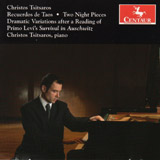 It may be premature, at best, to call Christos Tsitsaros a modern day Rachmaninoff, but it is a good reference point for considering his album. Tsitsaros, born in Cyprus in 1961 and educated in Warsaw, Paris, and University of Indiana (where he is currently on the faculty), is a top-flight piano virtuoso who writes dense, difficult music that matches his own technique. Like the great Russian, he is indifferent to stylistic trends, with music that is in a decidedly retro manner. A big difference is that Tsitsaros is not likely to be ridiculed for his conservatism, as was Rachmaninoff, in this age where anything goes, and no school of composition dominates. The three works here all bear the imprint of the composer/pianist, in the tradition of not only Rachmaninoff, but also Chopin, Beethoven, Mozart, and others. This is not to say that Tsitsaros necessarily belongs in these ranks, but you can hear the insights into technical matters in this music to which his own virtuosity led him. Another pianist of our day who writes music in this way is Marc-André Hamelin, although this side of his creativity is not well known.
 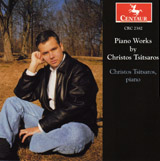 Tsitsaros's
music is conventionally tonal, but incorporating atmospheric
references to tonal inflections of the folk and church music
of his native Cyprus. Figurations and piano textures
which suggest piano music of the romantic era place the composer-who
is his own first-rate interpreter here-in the tradition of
virtuoso pianist-composers, who have often been drawn to write
vivid impressions of time and place like those contained in
this appealing recital.
Tsitsaros's
music is conventionally tonal, but incorporating atmospheric
references to tonal inflections of the folk and church music
of his native Cyprus. Figurations and piano textures
which suggest piano music of the romantic era place the composer-who
is his own first-rate interpreter here-in the tradition of
virtuoso pianist-composers, who have often been drawn to write
vivid impressions of time and place like those contained in
this appealing recital.